Inscriptions have been acting more as a “packing filler,” stuffed into any remaining space once higher-value monetary transfers are packed into blocks, said the firm.
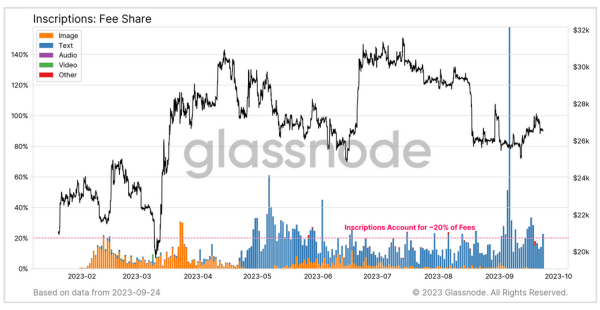
News Despite concerns that Bitcoin Ordinals are clogging the network, there is little evidence to suggest inscriptions are taking blockspace away from higher-value Bitcoin (BTC) monetary transfers. “There is minimal evidence that inscriptions are displacing monetary transfers,” on-chain analytics firm Glassnode explained its Sept. 25 “The Week On-chain” report. The firm explained that this is likely because inscription users tend to set low fee rates, expressing a willingness to wait longer periods of time for confirmation. Bitcoin Ordinals were introduced in February 2023 and have since accounted for the lion’s share of network activity when it comes to daily transaction count. However, this hasn’t necessarily been reflected in its share of mining fees, with inscriptions only attributing to about 20% of Bitcoin transaction fees, Glassnode noted. While inscriptions have strengthened the base-load demand for blockspace and increased fees for miners, Glassnode says Bitcoin’s hash rate has also increased 50% since February. This has resulted in tougher competition for miners looking to swoop in on revenue fees, says Glassnode: Bitcoin is currently priced at $26,216, but many industry pundits expect some degree of price appreciation in the lead-up to Bitcoin’s halving event scheduled for April 2024.
Currently, most inscriptions come as a result of BRC-20 tokens, which were introduced one month after Casey Rodarmor launched the Ordinals protocol on Bitcoin in February. On Sept. 25, Rodarmor pitched “Runes” as a potential alternative to BRC-20s, suggesting that an unspent transaction output-based fungible token protocol wouldn’t leave as many “junk” unspent transaction outputs on the Bitcoin network.

Join us on social networks
More inscriptions means more revenue — but there’s a catch